
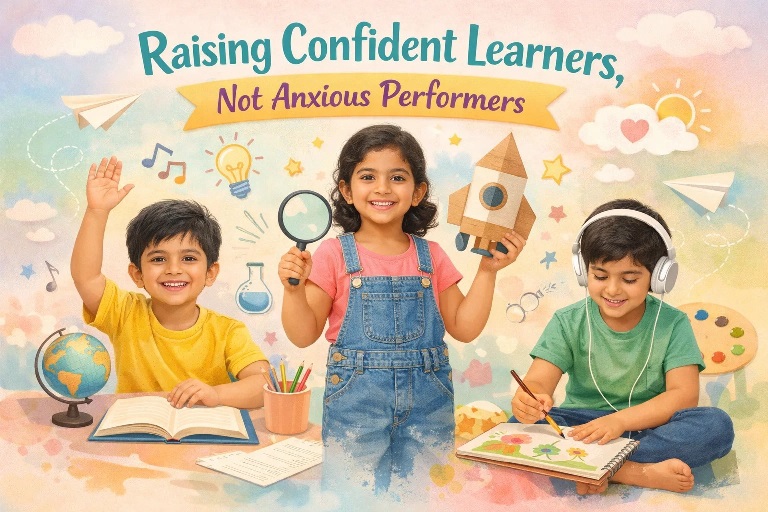
In today’s competitive academic environment, parents often focus heavily on grades and performance. While academic success is important, an excessive emphasis on marks can sometimes turn children into anxious performers rather than confident learners. Building confidence in primary school students is crucial, as it lays the foundation for lifelong learning and personal growth. In this article, we will explore how parents and educators can nurture confident learners, while also considering the approaches of different school curriculums, including CBSE, ICSE, and the International Baccalaureate (IB).
Understanding the Difference: Learners vs Performers
A confident learner is a child who enjoys the process of learning, asks questions freely, and is willing to make mistakes to understand concepts better. They are curious, resilient, and capable of thinking independently. On the other hand, an anxious performer is often motivated primarily by fear of failure or the pressure to achieve high grades. Such children may memorize information without understanding it, avoid challenges, and struggle with self-esteem when results do not meet expectations.
As parents, it is important to recognize these differences early and adjust guidance accordingly. Encouraging exploration, praising effort instead of just outcomes, and allowing children to fail and try again are key strategies for nurturing confidence.
Encouraging Concept-Based Learning
One of the most effective ways to raise confident learners is to focus on concept-based learning rather than rote memorization. Children should be guided to understand the “why” behind each concept. This approach not only helps in retaining knowledge for a longer time but also enables students to apply concepts in new situations, fostering creativity and problem-solving skills.
For example, in mathematics, instead of teaching formulas by rote, a tutor can demonstrate how the formula works through real-life examples. Similarly, in science, experiments and observations help children understand principles in a practical and engaging manner. When students comprehend concepts fully, they feel more confident in their abilities.
Balancing Curriculum Demands and Individual Learning
Different curriculums have different focuses. CBSE (Central Board of Secondary Education) emphasizes a balance between theory and application, ICSE (Indian Certificate of Secondary Education) focuses on detailed study and strong language skills, while IB (International Baccalaureate) encourages inquiry-based learning, critical thinking, and global awareness.
While CBSE and ICSE students may sometimes experience pressure due to exams and grades, IB students often face challenges in managing multiple projects and assignments. Regardless of the curriculum, the goal should always be to promote understanding over mere performance. Parents and tutors can help by creating a supportive environment where questions are welcomed, and learning is viewed as an enjoyable journey.
Role of Online Tuition in Building Confidence
Personalized online tuition can play a significant role in transforming anxious performers into confident learners. One-to-one sessions allow tutors to focus on the individual needs of a child, identify areas of difficulty, and adapt teaching methods accordingly. Children receive immediate feedback, guidance, and encouragement, which helps reduce anxiety and improve self-confidence.
A tutor experienced in multiple curriculums, including international boards, can guide students through challenging topics while maintaining a positive and motivating approach. Online classes also offer the flexibility to learn at a comfortable pace, making children feel secure and supported.
Practical Tips for Parents
Parents can complement academic support by encouraging a growth mindset at home. Praise efforts, curiosity, and problem-solving rather than just marks. Avoid comparing children with peers and celebrate small achievements. Provide opportunities for children to explore hobbies and creative activities outside academics. This holistic approach reduces anxiety and helps children develop confidence in multiple areas of life.
Conclusion
Raising confident learners requires a shift from a purely results-oriented approach to one that values understanding, curiosity, and personal growth. By focusing on concept clarity, encouraging questions, balancing curriculum demands, and providing personalized support through online tuition, parents can help their children become resilient, motivated, and confident learners.
By Nidhi Mehta – India Tutor Online
Class 1 to 6 All Subjects
Call/Whatsapp: +91 9811521621