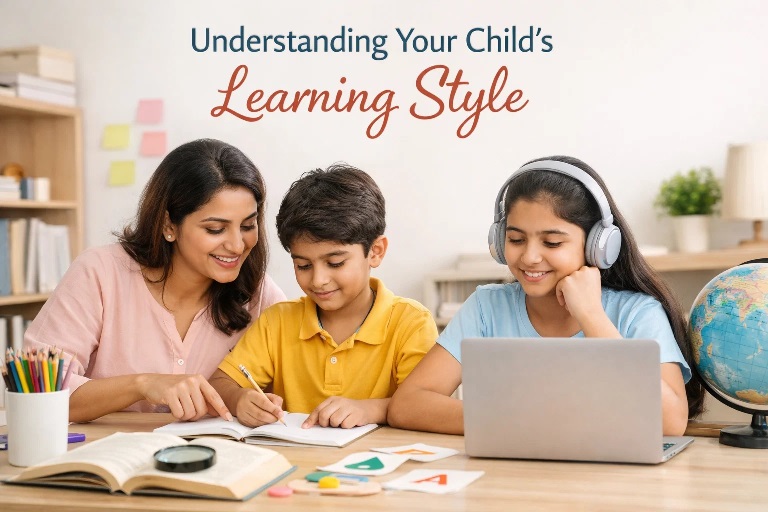
Every child is unique, not just in personality, but also in the way they learn. Understanding that every child learns differently is essential for parents, teachers, and tutors because it affects how children absorb information, solve problems, and perform in school. Recognizing these differences early can help provide the right guidance, support, and learning environment for each child.
Understanding Learning Styles
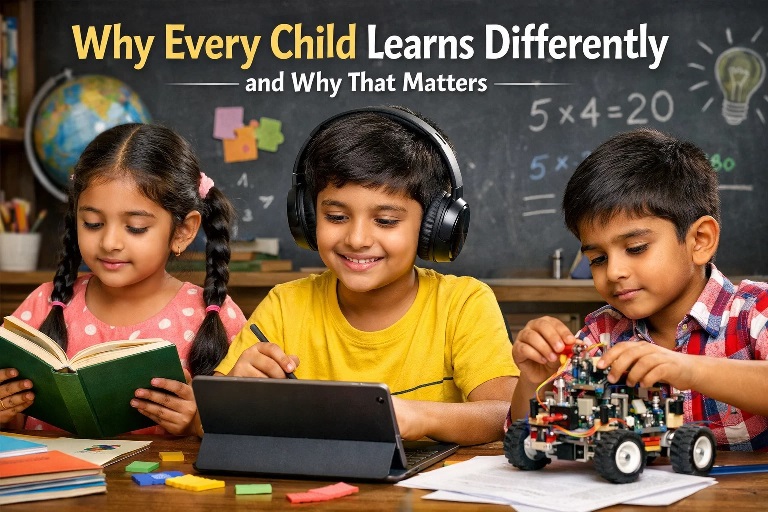
Children have different learning styles, which means they process and retain information in unique ways. Some children are visual learners, who understand concepts better through images, charts, and videos. Others are auditory learners, who grasp ideas more effectively when explained verbally. There are also kinesthetic learners, who learn best through hands-on activities, experiments, and movement.
These learning styles are not rigid. A child may use a combination of styles depending on the subject, mood, or topic. This is why a one-size-fits-all approach in classrooms often fails to reach every student effectively.
Learning Differences Across Students
Beyond learning styles, children also differ in pace, attention span, memory, and problem-solving strategies. Some students quickly grasp concepts but need practice to retain them, while others may take longer to understand but remember lessons for a longer time once learned.
Children also differ in motivation and confidence. A child struggling with math may become discouraged if the learning environment is not supportive, while another may thrive when challenged. Recognizing these differences allows teachers and parents to personalize learning, making it more effective and encouraging.
Impact of Different Curriculums
Internationally, school curriculums are designed differently, which also affects how children learn. For instance, the Indian CBSE curriculum focuses on structured knowledge and regular exams, while the ICSE curriculum emphasizes detailed understanding and language skills. The IB (International Baccalaureate) program encourages inquiry-based learning, critical thinking, and exploration, giving students more freedom to learn at their own pace.
Understanding the child’s curriculum is important because it helps align teaching methods with the style and expectations of the board. For example, a child in an IB school may respond better to discussion-based explanations and projects, while a CBSE student may need more structured problem-solving practice.
Why Individual Attention Matters
When each child learns differently, personalized attention becomes crucial. One-to-one tutoring or small group classes allow the tutor to adapt lessons according to the student’s learning style and pace. Personalized tuition can focus on areas of strength while addressing weaknesses, making learning more effective and less stressful for the child.
Parents often notice improvement when tutors adjust teaching methods to fit the child’s needs, rather than forcing every child into the same learning mold.
Supporting Different Learning Needs at Home
Parents can also support diverse learning needs at home. Observing how a child studies, what excites them, and where they struggle can provide valuable insights. Visual learners may benefit from charts, diagrams, and colorful notes, while auditory learners may benefit from reading aloud or listening to recordings. Kinesthetic learners can be encouraged through activities, experiments, and hands-on projects.
Combining home support with personalized online tuition ensures a holistic approach, improving both confidence and academic performance.
Conclusion
Every child’s learning journey is unique, and recognizing these differences is essential for academic success. Understanding a child’s learning style, pace, and motivation allows parents and tutors to provide tailored support that makes learning enjoyable and effective. Whether following the CBSE, ICSE, or IB curriculum, personalized attention and a supportive environment help children reach their full potential.
By Nidhi Mehta – India Tutor Online
Class 1 to 6 All Subjects
Call/Whatsapp: +91 9811521621